
Physicochemical Characterization of Spray-Dried Morinda citrifolia Extract Microcapsules Using an Alginate-Chitosan-STPP System
Article Sidebar
-
Morinda citrifolia, Spray-Drying, Microencapsulation, Polyelectrolyte Complex, Encapsulation Efficiency
Abstract
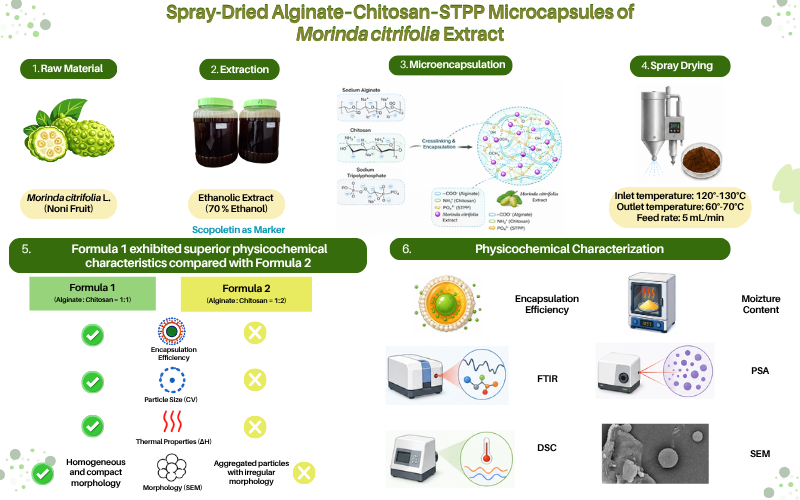
Scopoletin, the primary bioactive marker of Morinda citrifolia L. with antihyperlipidemic activity, is susceptible to thermal and oxidative degradation during processing and storage. Despite the established role of microencapsulation in protecting herbal bioactives, studies on spray-dried polyelectrolyte wall systems for Morinda citrifolia extract remain limited, particularly regarding the influence of chitosan concentration on microcapsule formation and encapsulation performance. This study investigated the effect of chitosan concentration on the physicochemical properties and scopoletin encapsulation efficiency of spray-dried alginate-chitosan-sodium tripolyphosphate (STPP) microcapsules. Morinda citrifolia fruit extract was prepared by maceration in 70% ethanol and characterized prior to microencapsulation. Two formulations differing in chitosan concentration were spray-dried: F1 (1% w/v) and F2 (2% w/v), with sodium alginate (1% w/v), STPP (0.1% w/v), and extract concentration held constant. Microcapsules were characterized by FTIR spectroscopy, particle size analysis (PSA), differential scanning calorimetry (DSC), moisture content determination, scanning electron microscopy (SEM), and scopoletin quantification via validated TLC–densitometry. FTIR confirmed extract integration into the polymer matrix through hydrogen bonding, electrostatic interactions, and ionic crosslinking, with more pronounced polyelectrolyte interactions in F1. F1 also exhibited a narrower particle size distribution, greater thermal stability, lower moisture content (3.38 ± 0.20%), and higher encapsulation efficiency (88.37%) than F2 (moisture: 4.89 ± 0.16%; EE: 72.09%; p = 0.043). SEM revealed greater particle discreteness in F1, whereas F2 exhibited denser aggregation. These results demonstrate that chitosan concentration critically governs polyelectrolyte complex formation and encapsulation performance, with F1 showing optimal physicochemical characteristics as a stable, standardized Morinda citrifolia-based oral herbal formulation.
References
AOAC International (2016). Official Methods of Analysis of AOAC International. AOAC International, Gaithersburg, MD, 20th edition.
Asita, N., M. S. Zubair, and Y. Syukri (2023). Formulasi Self-Nanoemulsifying Drug Delivery System (SNEDDS) yang Memanfaatkan Tanaman Obat: Narrative Review. Jurnal Sains Farmasi & Klinis, 10(2); 184–196. (in Indonesian).
Atma, Y., A. Sadeghpour, B. S. Murray, and F. M. Goycoolea (2025). Chitosan-Alginate Polyelectrolyte Complexes for Encapsulation of Low Molecular Weight Fish Bioactive Peptides. Food Hydrocolloids, 160; 110789.
Bhatia, S., Y. A. Shah, A. Al-Harrasi, M. Jawad, T. S. Khan, E. Koca, and L. Y. Aydemir (2024). Tuning the Structure and Physiochemical Properties of Sodium Alginate and Chitosan Composite Films Through Sodium Tripolyphosphate (STPP) Crosslinking. International Journal of Biological Macromolecules, 264(Part 2); 130463.
Busto, M. D., Y. González-Temiño, S. M. Albillos, S. Ramos-Gómez, M. C. Pilar-Izquierdo, D. Palacios, and N. Ortega (2022). Microencapsulation of a Commercial Food-Grade Protease by Spray Drying in Cross-Linked Chitosan Particles. Foods, 11; 2077.
Chemat, F., M. A. Vian, and G. Cravotto (2012). Green Extraction of Natural Products: Concept and Principles. International Journal of Molecular Sciences, 13(7); 8615–8627.
Chen, B., C. Ai, Y. He, Y. Zheng, L. Chen, and H. Teng (2024). Preparation and Structural Characterization of Chitosan–Sodium Alginate Nanocapsules and Their Effects on the Stability and Antioxidant Activity of Blueberry Anthocyanins. Food Chemistry: X, 23; 101744.
Chen, G.-L., H.-Y. Cai, J.-P. Chen, R. Li, S.-Y. Zhong, X.-J. Jia, X.-F. Liu, and B.-B. Song (2022). Chitosan/Alginate Nanoparticles for the Enhanced Oral Antithrombotic Activity of Clam Heparinoid from the Clam Coelomactra antiquata. Marine Drugs, 20(2); 136.
Chen, P., F. Xie, F. Tang, and T. McNally (2020). Unexpected Plasticization Effects on the Structure and Properties of Polyelectrolyte Complexed Chitosan/Alginate Materials. ACS Applied Polymer Materials, 2(7); 2957–2966.
Chendjou, S. M. S., R. K. T. Tsatsop, T. A. S. Zome, N. Amba, and S. B. Kenmogne (2025). A Screening Study of the Spray Drying Process for the Microencapsulation of Phenolic Compounds from Sarcocephalus latifolius (Sm.) Bruce Root Extracts Using a Two-Level Factorial Design. International Research Journal of Pure and Applied Chemistry, 26(3); 82–94.
Conzatti, G., D. Faucon, M. Castel, F. Ayadi, S. Cavalie, and A. Tourrette (2017). Alginate/Chitosan Polyelectrolyte Complexes: A Comparative Study of the Influence of the Drying Step on Physicochemical Properties. Carbohydrate Polymers, 172; 142–151.
Dewi, R. T., G. Primahana, A. W. Septama, M. Angelina, L. Meilawati, S. Fajriah, and G. F. Swandiny (2022). Quality Control Standardization of Indonesian Noni Fruit (Morinda citrifolia) Extract and Evaluation of Their Angiotensin-Converting Enzyme Inhibitory Activity. Pharmacia, 69(3); 709–717.
Díaz-Montes, E. (2023). Wall Materials for Encapsulating Bioactive Compounds via Spray-Drying: A Review. Polymers, 15(12); 2659.
Eghbal, N. and R. Choudhary (2018). Complex Coacervation: Encapsulation and Controlled Release of Active Agents in Food Systems. LWT–Food Science and Technology, 90; 254–264.
Estevinho, B. N. and A. López-Rubio (2024). Recent Advances in Encapsulation for Food Applications. Foods, 13(4); 579.
Facchi, D. P., A. P. Gerola, D. B. Scariot, L. C. Figueiredo, H. D. M. Follmann, A. C. de Oliveira, D. Lazarin-Bidóia, C. V. Nakamura, E. G. Bonafé, and A. F. Martins (2023). Chitosan, Chitosan Derivatives, and Chitosan-Based Nanocomposites: Eco-Friendly Materials for Advanced Applications. Frontiers in Chemistry, 11; 1327426.
Fahrudin, F. I., S. Phongthai, and P. Intipunya (2025). Enhancing Stability of Boesenbergia rotunda Bioactive Compounds: Microencapsulation via Spray-Drying and Its Physicochemical Evaluation. Foods, 14(15); 2699.
Forcepta, C., K. Nisa, and D. I. Anggraini (2021). Manfaat Buah Mengkudu (Morinda citrifolia) dalam Menurunkan Kadar Kolesterol Total dan LDL pada Penyakit Dislipidemia. Medula, 11(3); 253–258. (in Indonesian).
García-Jiménez, J. R., M. L. Luna-Guevara, J. J. Luna-Guevara, L. A. Conde-Hernández, M. E. Ramos-Cassellis, and H. Hernández-Cocoletzi (2024). Microencapsulation of Tecoma stans Extracts: Bioactive Properties Preservation and Physical Characterization Analysis. Foods, 13(7); 1001.
Gierszewska, M., J. Ostrowska-Czubenko, and E. Chrzanowska (2018). pH-Responsive Chitosan/Alginate Polyelectrolyte Complex Membranes Reinforced by Tripolyphosphate. European Polymer Journal, 101; 282–290.
Halahlah, A., V. Piironen, K. S. Mikkonen, and T. M. Ho (2023). Polysaccharides as Wall Materials in Spray-Dried Microencapsulation of Bioactive Compounds: Physicochemical Properties and Characterization. Critical Reviews in Food Science and Nutrition, 63(24); 6983–7015.
He, M., Y. Zheng, J. Shen, J. Shi, Y. Zhang, Y. Xiao, Y. Bai, Y. Zhang, X. Zhao, and Y. Qin (2024). Chitosan/Sodium Alginate Multilayer pH-Sensitive Films Based on Layer-by-Layer Self-Assembly for Intelligent Packaging. Journal of Renewable Materials, 12(2); 215–233.
Hou, S., D. Ma, S. Wu, Q. Hui, and Z. Hao (2025). Morinda citrifolia L.: A Comprehensive Review on Phytochemistry, Pharmacological Effects, and Antioxidant Potential. Antioxidants, 14(3); 295.
Iftitah, E. D., A. N. Putri, and A. K. Soesantyo (2025). Edible Coating of Cherry Tomatoes (Solanum lycopersicum) Based on Chitosan Nanoparticles (NPCh) and Mint (Mentha piperita) Essential Oil with Addition of Aloe Vera Gel. Science and Technology Indonesia, 10(2); 336–349.
Indonesian Ministry of Health (2017). Indonesian Herbal Pharmacopoeia. Ministry of Health Republic of Indonesia, Jakarta, Indonesia, 2nd edition.
International Council for Harmonisation of Technical Requirements for Pharmaceuticals for Human Use (2023). ICH Harmonised Guideline: Validation of Analytical Procedures Q2(R2). Technical report.
Jayanudin and Rochmadi (2017). Pengaruh Perbedaan Bahan Penyalut terhadap Efisiensi Enkapsulasi Oleoresin Jahe Merah. ALCHEMY Jurnal Penelitian Kimia, 13(2); 275–287. (in Indonesian).
Jha, A. K. and N. Sit (2022). Extraction of Bioactive Compounds from Plant Materials Using Combination of Various Novel Methods: A Review. Trends in Food Science & Technology, 119; 579–591.
Joshi, H., V. Gajera, and A. Katariya (2021). Review on Scopoletin: A Phenolic Coumarin with Its Medicinal Properties. International Journal of Pharmaceutical Sciences and Research, 12(7); 3567–3580.
Kumar, K. S., N. Kiruthiga, R. Arivukkarasu, S. D. Kumar, and M. Sureka (2024). Isolation and Quantification of Scopoletin from Leaves and Marketed Formulation of Morinda citrifolia L. Asia Pacific Journal of Pharmacotherapy and Toxicology, 4; 18–25.
Länger, R., E. Stöger, W. Kubelka, and K. Helliwell (2018). Quality Standards for Herbal Drugs and Herbal Drug Preparations—Appropriate or Improvements Necessary? Planta Medica, 84(6–7); 350–360.
Porras-Yepes, M., A. C. Rojas-Arias, and J. Hernández-Torres (2020). Microencapsulation of Bioactive Compounds: Techniques and Applications in Pharmaceutical and Food Industries. Journal of Food Process Engineering, 43(8); e13417.
Pudziuvelytė, L., M. Marksa, V. Jakštas, L. Ivanauskas, A. Laukevičienė, J. Bernatonienė, and D. M. Kopustinskienė (2022). Influence of Technological Factors on the Quality of Chitosan Microcapsules with Boswellia serrata L. Essential Oil. Molecules, 27(13); 4217.
Pudžiuvelytė, L., E. Petrauskaitė, J. Stabrauskienė, and J. Bernatonienė (2025). Spray-Drying Microencapsulation of Natural Bioactives: Advances in Sustainable Wall Materials. Pharmaceuticals, 18(7); 963.
Purwaningsari, D., S. Tehupuring, N. Pranitasari, S. Hayaza, L. Dewi, and D. Ardiana (2021). The Antioxidant Effect of Noni Fruits Extract on HDL and LDL Level of Wistar Rat Induced by High Fat Diet. Indian Journal of Forensic Medicine & Toxicology, 15(2); 2235–2239.
Safitri, A., D. R. T. Sari, and C. Mahdi (2022). Microencapsulation of Ruellia tuberosa L. Aqueous Root Extracts Using Chitosan–Sodium Tripolyphosphate and Their In Vitro Biological Activities. Scientifica, 2022; 9522463.
Saqueti, B. H., E. S. Alves, M. C. Castro, P. D. dos Santos, N. Sinosaki, C. E. Senes, J. V. Visentainer, and O. O. Santos (2021). Shelf Life of Bioactive Compounds from Acerola Pulp (Malpighia spp.) through Freeze-Drying and Microencapsulation. Journal of the Brazilian Chemical Society, 32; 2009–2016.
Song, Y., Y. Gu, A. Ren, X. Li, S. Wu, Y. Gong, and Y. Luo (2025). Optimization and Comprehensive Characterization of the Microencapsulation Process for Taro Essence. Foods, 14(5); 754.
Sreekumar, S., F. M. Goycoolea, B. M. Moerschbacher, and G. R. Rivera-Rodriguez (2018). Parameters Influencing the Size of Chitosan-TPP Nano- and Microparticles. Scientific Reports, 8; 4695.
Sulistiawanti, N., H. Hairunnisa, N. Ningrum, and S. Fitriyanti (2025). Review: Perbedaan Penggunaan Pelarut terhadap Nilai Rendemen yang Dihasilkan dengan Berbagai Metode Ekstraksi dalam Proses Ekstraksi. An-Najat, 3(3); 213–231.
Tasfiyati, A. N., L. D. Antika, R. T. Dewi, A. W. Septama, A. Sabarudin, and T. Ernawati (2022). An Experimental Design Approach for the Optimization of Scopoletin Extraction from Morinda citrifolia L. Using Accelerated Solvent Extraction. Talanta, 238; 123010.
Undale, V., N. Chaudhari, S. Bharud, and S. M. Firdous (2026). Comparative Analysis of Traditional and Modern Extraction Methods. In Advances in Extraction Science. CRC Press, pages 28–33.
Villate, A., M. San Nicolas, M. Olivares, O. Aizpurua-Olaizola, and A. Usobiaga (2023). Chitosan-Coated Alginate Microcapsules of a Full-Spectrum Cannabis Extract: Characterization, Long-Term Stability, and In Vitro Bioaccessibility. Pharmaceutics, 15(3); 859.
Widjastuti, T., L. Nurlaeni, A. Hasbuna, I. Setiawan, I. Yudaasmara, and W. Tanwiriah (2023). The Microencapsulation of Noni Fruit Extract (Morinda citrifolia L.) with Maltodextrin and Its Implementation as Feed Additive on Carcass Quality and Histology of Intestinal Sentul Chicken. International Journal on Advanced Science, Engineering and Information Technology, 13(1); 104–109.
Wigati, D. and K. Anwar (2017). Hypotensive Activity of Ethanolic Extracts of Morinda citrifolia L. Leaves and Fruit in Dexamethasone-Induced Hypertensive Rat. Journal of Evidence-Based Complementary & Alternative Medicine, 22(1); 107–111.
Wu, M., W. Zhang, H. Song, Y. Hu, and W. Li (2025). pH-Responsive Chitosan-Alginate Microcapsules as a Delivery System for Food-Medicine Homologous Plant Bioactives in Lung Cancer Therapy. Food Bioscience, 71; 107364.
Zhang, C., X. Chen, J. Zhang, P. A. Kilmartin, and S. Y. Quek (2020a). Fabrication of Spray-Dried Microcapsules Containing Noni Juice Using Blends of Maltodextrin and Gum Acacia: Physicochemical Properties of Powders and Bioaccessibility of Bioactives During In Vitro Digestion. Foods, 9(9); 1316.
Zhang, Y., L. Cui, X. Che, H. Zhang, N. Shi, C. Li, Y. Chen, and W. Kong (2020b). Preparation and Properties of Chitosan-Based Microspheres by Spray Drying. Food Science & Nutrition, 8(3); 1374–1383.
Authors

This work is licensed under a Creative Commons Attribution 4.0 International License.