
The Power of Interpolation Effects on SARIMA and LSTM: An Indonesia Domestic Forecasting Case Study
Article Sidebar
-
Sustainable Tourism, SARIMA, LSTM, Interpolation, Economic Growth
Abstract
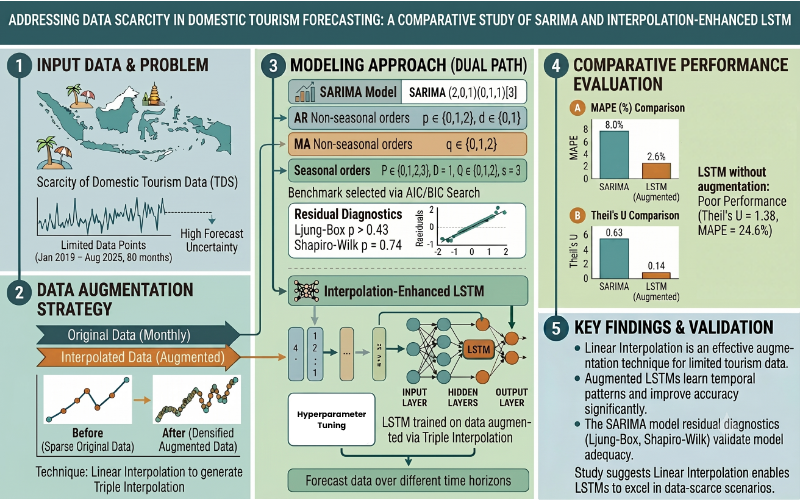
In regional economic planning, the accurate prediction of domestic tourism demand presents a critical challenge because limited access to historical time series data often causes advanced forecasting models to perform poorly. This study aims to demonstrate how linear interpolation can effectively serve as a data augmentation technique to overcome data scarcity when developing Long Short Term Memory (LSTM) networks to forecast domestic tourism arrivals. The methodology involves evaluating four distinct forecasting models using 80 months of Indonesian domestic tourism visitation data spanning from January 2019 to August 2025. These models include a statistical benchmark SARIMA (2,0,1)(0,1,1)[3] model selected via grid search out of 216 combinations and three LSTM variants run with identical random seeds. Performance evaluation is rigorously completed using MAE, RMSE, MAPE, sMAPE, and Theil’s U statistics. Key findings reveal that while unaugmented LSTM models perform poorly relative to a simple average baseline (Theil’s U = 1.38, MAPE = 24.6%), LSTMs enhanced with triple linear interpolation achieve superior predictive accuracy (MAPE = 2.6%, sMAPE = 2.6%, Theil’s U = 0.14). This approach significantly outperforms the benchmark SARIMA model (MAPE = 8.0%, Theil’s U = 0.63), which otherwise demonstrated adequate statistical validity through satisfactory residual diagnostics, including Ljung Box and Shapiro Wilk tests. In conclusion, the study demonstrates that utilizing linear interpolation as an augmentation technique is highly appropriate and effective, enabling deep learning models like LSTMs to accurately capture underlying temporal patterns from limited tourist arrival.
References
Ahmed, S. F., M. S. B. Alam, M. Hassan, M. R. Rozbu, T. Ishtiak, N. Rafa, M. Mofijur, A. B. M. Shawkat Ali, and A. H. Gandomi (2023). Deep Learning Modelling Techniques: Current Progress, Applications, Advantages, and Challenges. Artificial Intelligence Review, 56(11); 13521–13617.
Ajobo, S., O. O. Alaba, and A. Zaenal (2024). Generalised Space-Time Seasonal Autoregressive Integrated Moving Average Seemingly Unrelated Regression Modelling of Seasonal and Non-Stationary Data. Scientific African, 24; e02189.
Alamineh, G. A., J. W. Hussein, Y. Endaweke, and B. Taddesse (2023). The Local Communities’ Perceptions on the Social Impact of Tourism and Its Implication for Sustainable Development in Amhara Regional State. Heliyon, 9(6).
Ali, M., R. Jain, R. Joshi, and K. D. Gautam (2025). Dynamic Bayesian KNN with Confidence Intervals: A Reliable Imputation Method for High-Dimensional and Sparse Data. Engineering Letters, 33(12).
Ampountolas, A. (2021). Modeling and Forecasting Daily Hotel Demand: A Comparison Based on SARIMAX, Neural Networks, and GARCH Models. Forecasting, 3(3); 580–595.
Boto-García, D. and J. F. Baños Pino (2024). The Economics of Second-Home Tourism: Are There Expenditure Reallocation Effects from Accommodation Savings? Tourism Economics, 30(4); 969–995.
Box, G. E. P., G. M. Jenkins, G. C. Reinsel, and G. M. Ljung (2015). Time Series Analysis: Forecasting and Control. John Wiley & Sons.
Cho, K., B. Van Merriënboer, Ç. Gulçehre, D. Bahdanau, F. Bougares, H. Schwenk, and Y. Bengio (2014). Learning Phrase Representations Using RNN Encoder–Decoder for Statistical Machine Translation. In Proceedings of the 2014 Conference on Empirical Methods in Natural Language Processing (EMNLP). pages 1724–1734.
Choudhury, P., R. T. Allen, and M. G. Endres (2021). Machine Learning for Pattern Discovery in Management Research. Strategic Management Journal, 42(1); 30–57.
Deif, M. A., A. Bounceur, S. Mouakket, M. A. Hafez, and M. Elhoseny (2025). A Multi-Agent Framework for Detecting and Forecasting Silent Resistance in Organizational Communication: Implications for Open Innovation Dynamics. Journal of Open Innovation: Technology, Market, and Complexity; 100646.
Hajisafi, A., H. Lin, S. Shaham, H. Hu, M. D. Siampou, Y.-Y. Chiang, and C. Shahabi (2023). Learning Dynamic Graphs from All Contextual Information for Accurate Point-of-Interest Visit Forecasting. In Proceedings of the 31st ACM International Conference on Advances in Geographic Information Systems. pages 1–12.
He, K., L. Ji, C. W. D. Wu, and K. F. G. Tso (2021). Using SARIMA–CNN–LSTM Approach to Forecast Daily Tourism Demand. Journal of Hospitality and Tourism Management, 49; 25–33.
Ismail, M. T. and R. S. Al-Gounmeein (2022). Overview of Long Memory for Economic and Financial Time Series Dataset and Related Time Series Models: A Review Study. IAENG International Journal of Applied Mathematics, 52(2).
Li, B. and J. Gao (2022). Regional Tourism Economic Forecasting Model Based on GM Grey Forecasting Method. Mathematical Problems in Engineering, 2022(1); 3477246.
Lim, B. and S. Zohren (2021). Time-Series Forecasting with Deep Learning: A Survey. Philosophical Transactions of the Royal Society A, 379(2194); 20200209.
Montgomery, D. C., C. L. Jennings, and M. Kulahci (2015). Introduction to Time Series Analysis and Forecasting. John Wiley & Sons.
Okere, E. E. and V. Balyan (2025). A Deep Learning-Based Prediction and Forecasting of Tomato Prices for the Cape Town Fresh Produce Market: A Model Comparative Analysis. Forecasting, 7(2); 19.
Olukoya, O. (2023). Time Series-Based Quantitative Risk Models: Enhancing Accuracy in Forecasting and Risk Assessment. International Journal of Computer Applications Technology and Research, 12(11); 29–41.
Ordóñez-Martínez, D., J. M. Seguí-Pons, and M. Ruiz-Pérez (2023). Conceptual Framework and Prospective Analysis of EU Tourism Data Spaces. Sustainability, 16(1); 371.
Perez-Guerra, U. H., R. Macedo, Y. P. Manrique, E. A. Condori, H. I. Gonzáles, E. Fernández, N. Luque, M. G. Pérez-Durand, and M. García-Herreros (2023). Seasonal Autoregressive Integrated Moving Average (SARIMA) Time-Series Model for Milk Production Forecasting in Pasture-Based Dairy Cows in the Andean Highlands. PLoS One, 18(11); e0288849.
Ramadan, A., D. Rantini, B. D. Putri, Y. Widiyastusi, F. Amaliyah, N. Putu, E. K. Prayascita, I. I. Hakim, Z. Salsabila, M. M. Yandra, et al. (2025a). Economic Activity as a Catalyst for Tourism Development: A Spatial Analytical Perspective from Indonesia. IAENG International Journal of Applied Mathematics, 56(1); 402–414.
Ramadan, A., M. A. Syahputra, D. Rantini, R. A. Ningrum, M. N. Fakhruzzaman, A. Fajar, M. M. Yandra, N. A. Alya, M. F. A. Hillaby, A. Sesay, et al. (2025b). Predicting Surabaya’s Rainfall: A Comparative Study of Naïve Bayes, K-Nearest Neighbor, and Random Forest. Data and Metadata, 4; 1075–1075.
Rantini, D., N. Iriawan, and Irhamah (2021). On the Reversible Jump Markov Chain Monte Carlo (RJMCMC) Algorithm for Extreme Value Mixture Distribution as a Location-Scale Transformation of the Weibull Distribution. Applied Sciences, 11(16); 7343.
Rantini, D., R. Kruba, Y. J. Wijaya, M. M. Yandra, H. Rahman, A. Ramadan, F. Othman, et al. (2026). Predicting Upwelling Dynamics in the South Sea of Java, Indonesia: A Deep Learning Approach with ConvLSTM and 3D-CNN. MethodsX; 103802.
Saputra, D. E., D. Suandi, E. Tanuar, B. Siswanto, A. H. Rangkuti, N. W. Prasetya, S. E. D. Putra, P. D. Kusuma, et al. (2025). Comparative Analysis of Machine Learning Models for Predicting Water Salinity Levels. IAENG International Journal of Computer Science, 52(12).
Schaffer, A. L., T. A. Dobbins, and S.-A. Pearson (2021). Interrupted Time Series Analysis Using Autoregressive Integrated Moving Average (ARIMA) Models: A Guide for Evaluating Large-Scale Health Interventions. BMC Medical Research Methodology, 21(1); 58.
Suprihadi, E., N. Danila, and Z. Ali (2025). Enhancing Financial Product Forecasting Accuracy Using EMD and Feature Selection with Ensemble Models. Journal of Open Innovation: Technology, Market, and Complexity, 11(2); 100531.
Taylor, S. J. and B. Letham (2018). Forecasting at Scale. The American Statistician, 72(1); 37–45.
Torres, J. F., D. Hadjout, A. Sebaa, F. Martínez-Álvarez, and A. Troncoso (2021). Deep Learning for Time Series Forecasting: A Survey. Big Data, 9(1); 3–21.
Vu, K. and K. Hartley (2022). Drivers of Growth and Catch-Up in the Tourism Sector of Industrialized Economies. Journal of Travel Research, 61(5); 1156–1172.
Wu, D. C., S. Zhong, J. Wu, and H. Song (2025). Tourism and Hospitality Forecasting with Big Data: A Systematic Review of the Literature. Journal of Hospitality & Tourism Research, 49(3); 615–634.
Authors

This work is licensed under a Creative Commons Attribution 4.0 International License.